The idea in brief
The lost-civilisation hypothesis proposes that a technologically and culturally advanced society existed during the last Ice Age, before about 12,000 years ago. In the version made famous by Graham Hancock, this culture:
- was seafaring and had sophisticated knowledge of astronomy, geodesy and architecture;
- was largely destroyed by the cataclysms at the end of the Ice Age, such as a possible cosmic impact (see Younger Dryas Impact), meltwater floods and a sea-level rise of roughly 120 metres;
- had survivors who passed fragments of knowledge, including agriculture, monumental building and calendrical astronomy, to hunter-gatherer peoples around the world. Myths remember them as the “sages”, “Followers of Horus”, Viracocha, Quetzalcoatl or the Mesopotamian Apkallu.
Hancock is careful to say he is not describing a modern industrial civilisation. He suggests something closer to the level of 18th-century Europe in navigation and science, but with different technologies. Other proponents argue for more advanced capabilities, especially in stoneworking (see Precision Megalithic Stonework).
History of the idea
- Plato (c. 360 BCE). In the dialogues Timaeus and Critias, an Egyptian priest tells the Athenian statesman Solon of Atlantis. It was a powerful island empire “beyond the Pillars of Heracles” that sank in a single day and night, 9,000 years before Solon’s time. That puts it around 9600 BCE, a date that intriguingly lines up with the end of the Younger Dryas.
- Ignatius Donnelly, Atlantis: The Antediluvian World (1882). The American congressman turned Atlantis into a modern theory, arguing it was the mother culture of Egypt and the Americas.
- Charles Hapgood (1958, 1966). In Earth’s Shifting Crust, which carried a foreword by Albert Einstein, Hapgood proposed that Earth’s crust slips over its mantle. In Maps of the Ancient Sea Kings he argued that Renaissance maps such as the 1513 Piri Reis map preserve surveys of coastlines from an Ice Age culture.
- John Anthony West, Serpent in the Sky (1979). West, following the French esotericist R. A. Schwaller de Lubicz, argued that Egyptian civilisation was a legacy rather than a development. He later recruited geologist Robert Schoch to examine the Sphinx.
- Graham Hancock, Fingerprints of the Gods (1995). The book sold millions of copies and set the modern form of the hypothesis. It was followed by Underworld (2002, on submerged sites), Magicians of the Gods (2015, linking it to the Younger Dryas impact) and America Before (2019, on the Americas).
- Netflix, Ancient Apocalypse (2022, season 2 2024). This brought the ideas to a new generation and drew a formal response from the archaeological establishment.
Key evidence cited by proponents
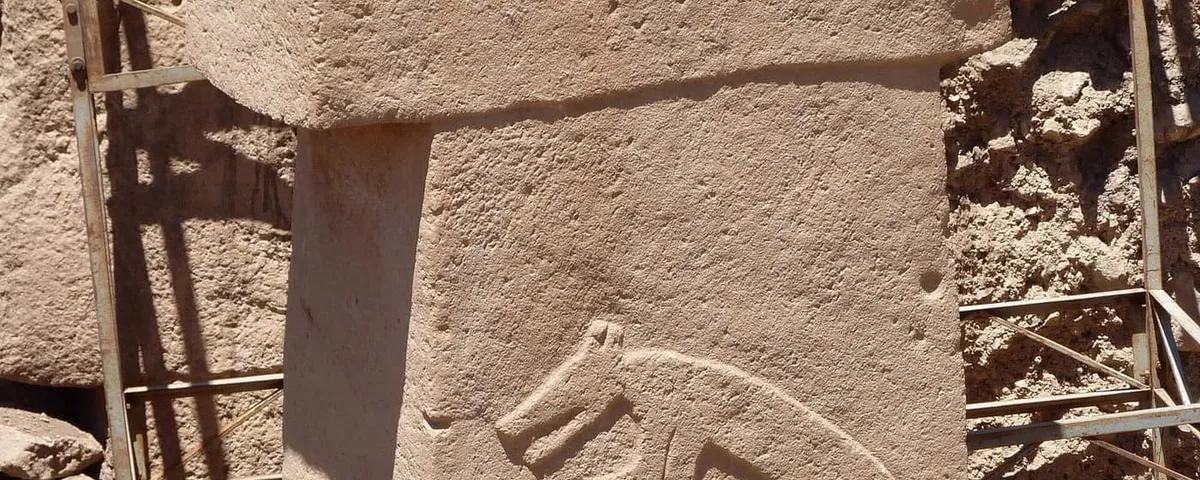
- Göbekli Tepe and Karahan Tepe (c. 9600–8200 BCE). These are monumental enclosures of carved T-shaped pillars built at the very end of the Ice Age, apparently before farming. To proponents, their sophistication implies knowledge inherited from an earlier tradition. They also note that the enclosures were deliberately backfilled.
- The Sphinx water-erosion hypothesis. Schoch argues that the deep vertical weathering of the Sphinx enclosure was produced by sustained rainfall. That would push its origin back to before 5000 BCE, and possibly much earlier (see Giza & Saqqara).
- Gunung Padang. A 2023 paper claimed buried man-made layers 16,000–27,000 years old. It was retracted in 2024.
- Submerged landscapes. At the Last Glacial Maximum, about 20,000 years ago, sea level was roughly 120 m lower. Large, habitable coastal plains such as Sundaland, Doggerland, the Persian Gulf basin and the Bahamas Banks are now underwater. Hancock argues that this is exactly where an Ice Age seafaring culture would have lived, and that it is almost unexplored. He cites Yonaguni as a possible example.
- Global flood and sage myths. Recurring stories of a flood and of culture-bringers who arrive by sea, from Mesopotamia’s Apkallu and Egypt’s Edfu texts to the Andean Viracocha.
- Astronomical “encoding”. Proposed correlations between monuments and the sky around 10,500 BCE (see Astronomical Alignments).
- Deep time in the Americas. America Before points to Amazonian earthworks, terra preta soils and the shifting date for the first Americans as evidence that history there is older and more complex than once taught.
Who champions it
- Graham Hancock is the principal modern author of the hypothesis.
- Robert Schoch sees the Sphinx and Göbekli Tepe as evidence of earlier cultures disrupted by catastrophe. He favours solar outbursts over a comet.
- Randall Carlson brings geology and catastrophism.
- Jimmy Corsetti (Bright Insight) has popularised Atlantis-location theories, notably the Richat Structure in Mauritania.
- Dan Richards argues for the hypothesis and against what he sees as unfair dismissals.
- Andrew Collins, Matthew LaCroix and Freddy Silva each develop their own versions, from Anatolian origins to a lost “Ararat” culture to temple traditions.
The mainstream view, in fair depth
Archaeologists generally reject the hypothesis. Their main arguments are:
- Missing material culture. Every known society leaves rubbish: tools, pottery, bones, hearths, quarries and mines. Archaeologists argue that a civilisation able to teach agriculture and astronomy worldwide would leave detectable traces on land, such as inland sites, mining waste, domesticated plants and animals, and metal. None have been found.
- Domestication genetics. DNA from wheat, barley, rice, maize, dogs, goats and cattle shows independent, gradual domestication in several regions over thousands of years. It does not show a single transfer of “gifted” crops.
- Göbekli Tepe in context. The excavators of the German Archaeological Institute see Göbekli Tepe as the work of complex hunter-gatherers in a region already rich in wild cereals. Newer work has found domestic buildings, rainwater cisterns and tools in daily use, suggesting people lived there. To them the site upends old assumptions about hunter-gatherers, not the existence of a lost civilisation.
- The Sphinx. Most Egyptologists and many geologists attribute the weathering to salt crystallisation, runoff and the poor quality of the limestone. They tie the monument to Khafre’s building programme (c. 2550 BCE).
- Myth is not a record. Flood myths are common because floods are common. Culture-hero myths reflect how societies explain their origins.
- Public criticism. In November 2022 the Society for American Archaeology wrote an open letter to Netflix. It objected that Ancient Apocalypse presented the theory as documentary without evidence and disparaged archaeologists. In April 2024, Hancock debated archaeologist Flint Dibble on the Joe Rogan Experience podcast in a four-hour exchange that covered most of these points.
Current state of research
The scientific picture of the deep past has changed dramatically in the past 25 years, and both sides cite the changes.
- Older and more complex hunter-gatherers. Göbekli Tepe, Karahan Tepe and the wider “Taş Tepeler” project in south-eastern Turkey (Türkiye) show monumental building and symbolic art at the very start of the Holocene. Even sceptics describe this as rewriting the textbooks.
- Deep time in the Americas. Human footprints at White Sands, New Mexico, dated to about 21,000–23,000 years ago (Bennett et al., Science, 2021; later re-dated with additional methods), have pushed back the peopling of the Americas. They overturned the old “Clovis first” model.
- Lost cities in the Amazon. LiDAR surveys have revealed large, planned urban landscapes. Examples are the Casarabe culture in Bolivia (Prümers et al., Nature, 2022) and the Upano Valley in Ecuador, about 2,500 years old (Rostain et al., Science, 2024). These match Hancock’s claim that the Amazon was not pristine wilderness, though not his deeper timeline.
- Submerged prehistory. Underwater archaeology has confirmed drowned settlements. Atlit Yam off Israel is a Neolithic village around 9,000 years old, and Doggerland in the North Sea has yielded artefacts. No Ice Age city has been found.
- Early seafaring. People reached Australia by sea at least 50,000–65,000 years ago. That shows open-water navigation is far older than once believed.
Open questions
- What lies on the drowned continental shelves of the Ice Age? Systematic surveys of Sundaland, the Gulf and the Black Sea are only beginning.
- Why did monumental building appear so suddenly in Anatolia around 9600 BCE?
- How early did humans develop sophisticated astronomy and calendars?
- Could a small, coastal, maritime culture leave too little inland trace to detect with today’s methods?
- How should researchers and the public talk to each other about these questions? Both sides have argued that the other has been dismissive.
Further reading & watching
- Graham Hancock, Fingerprints of the Gods (1995), Magicians of the Gods (2015), America Before (2019).
- Robert M. Schoch, Forgotten Civilization (2012).
- Klaus Schmidt, Göbekli Tepe: A Stone Age Sanctuary (2012). The excavator’s account.
- Netflix, Ancient Apocalypse (2022, 2024).
- Researcher interviews and podcasts: see Voices and Resources.
- Tours: Göbekli Tepe, Giza, Malta and the full directory.
Sources
- Plato, Timaeus and Critias, trans. B. Jowett (Project Gutenberg). https://www.gutenberg.org/ebooks/1572
- Ancient Apocalypse: reception and SAA letter (Wikipedia summary). https://en.wikipedia.org/wiki/Ancient_Apocalypse
- Bennett, M. R. et al. (2021). Evidence of humans in North America during the Last Glacial Maximum. Science 373. https://doi.org/10.1126/science.abg7586
- Prümers, H. et al. (2022). Lidar reveals pre-Hispanic low-density urbanism in the Bolivian Amazon. Nature 606. https://doi.org/10.1038/s41586-022-04780-4
- Rostain, S. et al. (2024). Two thousand years of garden urbanism in the Upper Amazon. Science 383. https://doi.org/10.1126/science.adi6317
- DAI Göbekli Tepe research blog, Tepe Telegrams. https://www.dainst.blog/the-tepe-telegrams/
- Atlit Yam (Wikipedia, with references). https://en.wikipedia.org/wiki/Atlit_Yam
- Doggerland (Wikipedia, with references). https://en.wikipedia.org/wiki/Doggerland
- UNESCO World Heritage: Göbekli Tepe. https://whc.unesco.org/en/list/1572