The idea in brief
“Out-of-place artefacts”, or OOPArts, are objects that seem too advanced for their age, or found in a place or rock layer where they should not be. The idea is usually credited to the American naturalist Ivan T. Sanderson, who wrote about “out of place things” in the 1960s; later writers turned it into the acronym. Supporters argue that such objects show that ancient people, or someone else, once had technologies that were later lost. Legends of giants, from the Nephilim of Genesis to Sardinia’s “giants’ tombs”, are often discussed alongside them.
The category is a mixed bag, and that is what makes it interesting:
- Some OOPArts are genuine wonders that really did change how we see ancient science.
- Some are real objects that have been misread, where the debate is about interpretation.
- A few are hoaxes or modern objects that were mistaken for ancient ones.
Sorting them into these groups is the best way to understand the wider argument about lost knowledge.
History of the idea
- 19th-century curiosities. Newspapers in the 1800s regularly reported strange objects found in coal or rock, and giant skeletons dug out of mounds. Many of these stories cannot be traced to any surviving object.
- The Cardiff Giant (1869). A 3-metre “petrified man” was dug up on a farm in New York State. It was a gypsum carving commissioned by tobacconist George Hull, reportedly after an argument about the giants of Genesis 6:4, and it became the most famous hoax of its kind.
- Charles Fort, The Book of the Damned (1919). Fort collected reports of anomalies that science ignored, and inspired later writers.
- Ivan T. Sanderson (1960s). He gave the phenomenon a name and treated anomalous objects as data worth collecting.
- Charles Hapgood, Maps of the Ancient Sea Kings (1966). Hapgood argued that Renaissance maps such as the Piri Reis map preserved knowledge from a lost civilisation of global explorers.
- Erich von Däniken, Chariots of the Gods? (1968). Von Däniken presented many such objects as evidence of ancient astronauts; see the ancient-astronaut explainer.
- Michael Cremo & Richard L. Thompson, Forbidden Archeology (1993). Cremo argued that evidence of anatomically modern humans in very deep time had been filtered out of the scientific record by a “knowledge filter”.
- 2010s–2020s. YouTube channels and TV series such as Ancient Aliens brought these objects to a huge audience. New lab work has also solved some old puzzles, such as Tutankhamun’s dagger, and opened new ones, such as the precision stone vases of early Egypt.
Key evidence cited by proponents
The genuine wonders
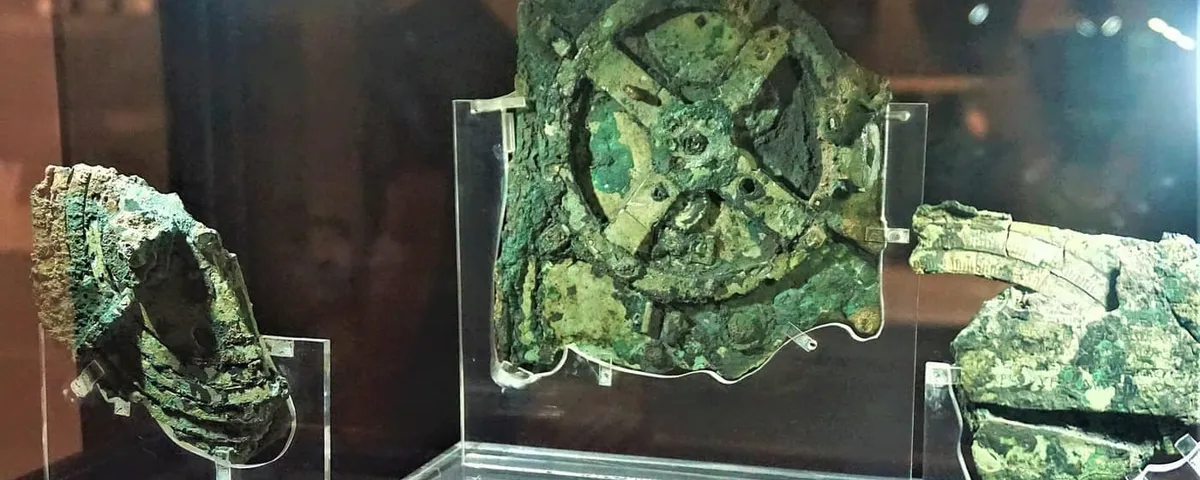
- The Antikythera mechanism (2nd–1st century BCE). A hand-powered bronze geared device recovered from a Roman-era shipwreck off the Greek island of Antikythera in 1900–1901. X-ray CT scans show it once had about 35 meshing gears. It tracked the Sun and Moon through the zodiac, showed the Moon’s phases, predicted eclipses and modelled the Moon’s irregular orbit. In 2021 Tony Freeth and colleagues published a reconstruction of the front of the device as a model of the cosmos, including the planets. A 2024 study suggested its calendar ring had 354 holes, a lunar year (discovery entry). Nothing comparable is known for many centuries afterwards, which makes it a true “lost technology”.
- Meteoritic iron. Tutankhamun’s iron dagger blade has a nickel and cobalt content that matches iron meteorites (Comelli et al. 2016). A Bronze Age arrowhead from Mörigen in Switzerland was made of iron from a meteorite that fell in Estonia, about 1,600 km away (entry). People worked “iron from the sky” before iron smelting became common.
- Roman concrete. A 2023 study showed that lime clasts from “hot mixing” let Roman concrete heal its own cracks, a property modern engineers are now copying (entry).
- The Roman dodecahedra. About 130 hollow bronze twelve-sided objects have been found in the north-western Roman provinces, but not in Italy. Their purpose is still unknown (entry).
Real objects, contested readings
- The “Baghdad battery”. A clay jar with a copper cylinder and an iron rod, probably from the Parthian or Sasanian period. In the 1930s Wilhelm König, at the National Museum of Iraq, suggested it was a galvanic cell used for electroplating. Replicas filled with an acidic liquid do produce a small voltage.
- The Dendera “lights”. Reliefs in the crypts of the Hathor temple at Dendera show a large bulb-like shape with a wavy line inside, supported by a djed pillar. Some authors read them as electric lamps with filaments and insulators.
- The Saqqara Bird. A wooden bird model found in an 1898 excavation of a tomb at Saqqara. Egyptian physician Khalil Messiha suggested it was a model glider, evidence that the ancient Egyptians understood flight.
- The Piri Reis map (1513). An Ottoman map that Hapgood and later writers, including Graham Hancock in Fingerprints of the Gods, have argued shows the coast of Antarctica free of ice.
- Precision stone vases. Hard-stone vessels from predynastic and early dynastic Egypt, some of which are strikingly round and symmetrical when 3D-scanned. Ben van Kerkwyk of UnchartedX argues there are “two industries”: a non-precise category consistent with hand tools, and a precise category that implies a much more advanced technology.
Probable hoaxes and modern objects
- The Ica stones (Peru). Engraved andesite stones that show dinosaurs, surgery and telescopes. Physician Javier Cabrera collected about 20,000 of them, most bought from the farmer Basilio Uschuya, who later admitted making them for profit. Some ancient-astronaut writers still cite them.
- The Coso artifact (1961). A “spark plug in a geode” found near Olancha, California. It was later identified as a 1920s Champion spark plug in a natural concretion.
- The London Hammer (1936). A hammer partly encased in rock, found near London, Texas. It matches 19th-century mining hammers; the surrounding rock is a concretion that can form quickly.
- The Klerksdorp spheres (South Africa). Small spheres and discs from 3-billion-year-old rock. Geologists who studied them conclude they are natural concretions.
Giants
- Myths. The Nephilim (Genesis 6), Greek Titans and Cyclopes, Norse jötnar, and Andean stories that giants built Tiwanaku before a flood.
- Megalithic “giants’ tombs”. Sardinia’s tombe dei giganti and the Mont’e Prama statues, stone warriors 2 to 2.6 m tall (entry). In Malta, the temples of Ġgantija on Gozo were said to have been built by a giantess (Malta guide).
- Proponent claims. 19th-century newspaper reports of giant skeletons in American mounds, and Paiute stories of red-haired giants linked to Lovelock Cave in Nevada. Hugh Newman and Jim Vieira collect these accounts in Giants on Record (2015) and argue that the evidence was ignored or lost.
Who champions it
- Erich von Däniken and Giorgio A. Tsoukalos have presented OOPArts as signs of ancient contact.
- Michael Cremo argued for extreme human antiquity and a “knowledge filter” in science.
- Ben van Kerkwyk focuses on precision stone vases and machining marks in Egypt.
- Brien Foerster writes about lost ancient technology in Peru, Bolivia and Egypt.
- Hugh Newman researches giant lore and megalithic sites, and leads tours to Sardinia and Malta.
The mainstream view, in fair depth
- The wonders are real, and they are human. Historians of science treat the Antikythera mechanism as the high point of Hellenistic astronomy and engineering. Its inscriptions are in Greek, its astronomy matches Babylonian and Greek theory, and Cicero’s De re publica (54–51 BCE) describes a similar sphere attributed to Archimedes that showed the motions of the Sun, Moon and planets. Its loss shows how fragile the record of skilled craft can be, not that outsiders were involved.
- The “battery”. No wires, conductors or electroplated objects are known from the period, and archaeologists reject the electrical reading. Similar sealed jars found at Seleucia contained rolls of decomposed papyrus or fibre, which suggests they were used to store scrolls.
- The Dendera reliefs. Egyptologists point to the hieroglyphic texts carved right next to the images. They describe the god Harsomtus emerging as a snake from a lotus flower on a sacred barque, a creation scene, not a lamp.
- The Saqqara Bird. Most Egyptologists see it as a model of a bird, possibly a toy for an elite child or a weather vane, rather than an aircraft model.
- The Piri Reis map. Historians of cartography read the southern coastline as a distorted South America, bent to fit the edge of the parchment. Scholars also note that it partly copies a now-lost map by Christopher Columbus, which explains other oddities such as the shape of the Caribbean.
- The stone vases. Egyptologists date the vessels to the Naqada and early dynastic periods and attribute them to skilled workshops using stone drills, abrasives and long practice. The precision question is now debated with scan data on both sides: in April 2026 researcher Max Fomitchev-Zamilov argued that the most precise examples, which he did not find in the Petrie Museum’s collection, are modern fakes. Van Kerkwyk replied that the Artifact Foundation did scan precise vessels at the Petrie Museum and that the comparison is incomplete.
- Hoaxes. The Cardiff Giant, the Ica stones and the Coso artifact show how easily objects can be faked or misidentified, which is why museums insist on a documented find context.
- Giants. No verified skeleton of a human much taller than about 2.7 m exists; the tallest person with irrefutable records, Robert Wadlow, reached 2.72 m. Folklorist Adrienne Mayor suggests that the Lovelock Cave “giants” began as tourist displays and that the skeletons were of normal size, while large mammoth and cave-bear bones were often taken for giants’ bones. Many scholars think huge megaliths inspired giant legends, rather than the other way round.
- Forbidden Archeology. Scholars of archaeology and palaeoanthropology describe the book as pseudoscience. Its critics argue that the claimed anomalies come from old or poorly documented finds.
Current state of research
- The Antikythera mechanism is still being studied with new imaging and statistical methods, such as the 2024 analysis of its calendar ring.
- Archaeometallurgy keeps finding meteoritic iron in Bronze Age objects, refining when and where people first worked iron.
- The precision-vase debate has moved from opinion to measurement, with groups publishing 3D scans and quality metrics. Agreed standards for what counts as “precise” are still missing.
- Roman dodecahedra keep turning up in excavations and metal-detecting finds, adding context but no agreed answer.
- Several famous OOPArts, such as the Coso artifact and the London Hammer, are effectively solved, but they remain popular online.
Open questions
- What else did the makers of the Antikythera mechanism build? Ancient writers mention geared planetaria, but none other survives.
- What were the Roman dodecahedra for?
- How exactly were the most precise early Egyptian stone vessels made, and how many are securely provenanced?
- Why do giant legends appear so widely, and how much were they shaped by megaliths and fossil bones?
- How many genuine anomalies are hidden in museum stores without a recorded find context?
Related places on this site
- Abydos, Dendera & the Serapeum for the Dendera reliefs.
- Giza & Saqqara for the Saqqara Bird and early Egyptian stonework.
- Sardinia’s nuraghe & giants’ tombs and Malta’s temples for giant lore.
- Precision megalithic stonework and ancient astronauts.
Further reading
- Jo Marchant, Decoding the Heavens (2008), on the Antikythera mechanism.
- Hugh Newman & Jim Vieira, Giants on Record (2015).
- Michael Cremo & Richard L. Thompson, Forbidden Archeology (1993).
- Charles Hapgood, Maps of the Ancient Sea Kings (1966).
- UnchartedX, “Ancient Precision Vases are Fakes Again?” (2026), for the vase debate from the alternative side.
Sources
- Out-of-place artifact (Wikipedia). https://en.wikipedia.org/wiki/Out-of-place_artifact
- Antikythera mechanism (Wikipedia, with references). https://en.wikipedia.org/wiki/Antikythera_mechanism
- Freeth et al. 2021, “A Model of the Cosmos in the ancient Greek Antikythera Mechanism”, Scientific Reports. https://doi.org/10.1038/s41598-021-84310-w
- Comelli et al. 2016, “The meteoritic origin of Tutankhamun’s iron dagger blade”, Meteoritics & Planetary Science. https://doi.org/10.1111/maps.12664
- Hofmann et al. 2023, meteoritic iron arrowhead from Mörigen, Journal of Archaeological Science. https://doi.org/10.1016/j.jas.2023.105827
- Seymour et al. 2023, Roman concrete, Science Advances. https://doi.org/10.1126/sciadv.add1602
- Roman dodecahedron (Wikipedia). https://en.wikipedia.org/wiki/Roman_dodecahedron
- Baghdad Battery (Wikipedia). https://en.wikipedia.org/wiki/Baghdad_Battery
- Dendera light (Wikipedia). https://en.wikipedia.org/wiki/Dendera_light
- Saqqara Bird (Wikipedia). https://en.wikipedia.org/wiki/Saqqara_Bird
- Piri Reis map (Wikipedia). https://en.wikipedia.org/wiki/Piri_Reis_map
- UnchartedX, “Ancient Precision Vases are Fakes Again?” (20 May 2026). https://unchartedx.com/site/2026/05/20/precise-vases-are-fakes-again/
- Ica stones (Wikipedia). https://en.wikipedia.org/wiki/Ica_stones
- Coso artifact (Wikipedia). https://en.wikipedia.org/wiki/Coso_artifact
- London Hammer (Wikipedia). https://en.wikipedia.org/wiki/London_Hammer
- Klerksdorp sphere (Wikipedia). https://en.wikipedia.org/wiki/Klerksdorp_sphere
- Cardiff Giant (Wikipedia). https://en.wikipedia.org/wiki/Cardiff_Giant
- Lovelock Cave (Wikipedia). https://en.wikipedia.org/wiki/Lovelock_Cave
- Giants of Mont’e Prama (Wikipedia). https://en.wikipedia.org/wiki/Giants_of_Mont%27e_Prama
- Robert Wadlow (Wikipedia). https://en.wikipedia.org/wiki/Robert_Wadlow
- Forbidden Archeology (Wikipedia). https://en.wikipedia.org/wiki/Forbidden_Archeology