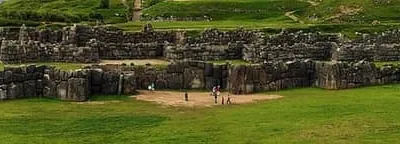
Zig-zag walls of gigantic polygonal blocks above Cusco, plus nearby Tiwanaku and Puma Punku in Bolivia.
Polygonal megalithic walls at Sacsayhuamán. Photo: Martin St-Amant (S23678) / Wikimedia Commons, CC BY 3.0
The alternative view
Brien Foerster and others propose that the lowest, finest megalithic courses were built by an earlier culture and later reused by the Inca; some suggest stone-softening techniques.
The mainstream view
Most archaeologists attribute Sacsayhuamán to the Inca (15th c.); Jean-Pierre Protzen’s experiments reproduced Inca fitting with hammerstones.
We present both views respectfully and link to the original work so you can judge for yourself.
A Science news feature reports that Andean archaeologists are replacing the traditional Inca chronology (empire from 1438) with radiocarbon dates. At Saqsaywaman, dated charcoal suggests the site began to be remodelled with fitted masonry around 1400, with construction peaking from about 1418; the first results are in press at Antiquity.
Researchers analysed 138 dispersed blocks from a dismantled sector, using geometric silhouettes and computational matching, to propose how the early Inca walls fitted together.
Author and long-time Peru resident who leads Hidden Inca Tours. He researches megalithic stonework, elongated skulls and pre-Inca construction in Peru, Bolivia and Egypt.
Founder of UnchartedX, focused on precision stonework, machining marks and ancient high technology, especially in Egypt and Peru. He runs annual special-access Egypt tours with the Brothers of the Serpent and Yousef Awyan.
Founder and host of Project Unity, an interview and field-video channel on ancient sites, lost history and anomalous phenomena. He regularly hosts researchers from across the alternative-history community.